
.png)
Medically reviewed by Mr Rob Laycock, Consultant Maxillofacial and Cosmetic Surgeon, GMC 6145445. Last reviewed September 2026.
Under eye hollows are caused by the loss of fat, bone and skin support around the eye socket, which deepens the tear trough, the natural groove between the lower lid and the cheek. Genetics determine how early it shows, ageing determines how far it progresses, and most people notice the change from their late 30s onwards.
What Is The Tear Trough?
The tear trough is the groove that runs from the inner corner of the eye, along the lower lid, towards the cheek. Everyone has one. It is a normal part of facial anatomy, not a flaw, and it exists because the skin of the lower lid is anchored to the bone beneath it along a fixed line.
Under eye hollows are what happens when that groove becomes deep enough to cast a shadow. The anatomy has not changed. What has changed is the volume and support on either side of it.
What Causes Under Eye Hollows To Develop?
Four things change around the eye with age, and they compound.
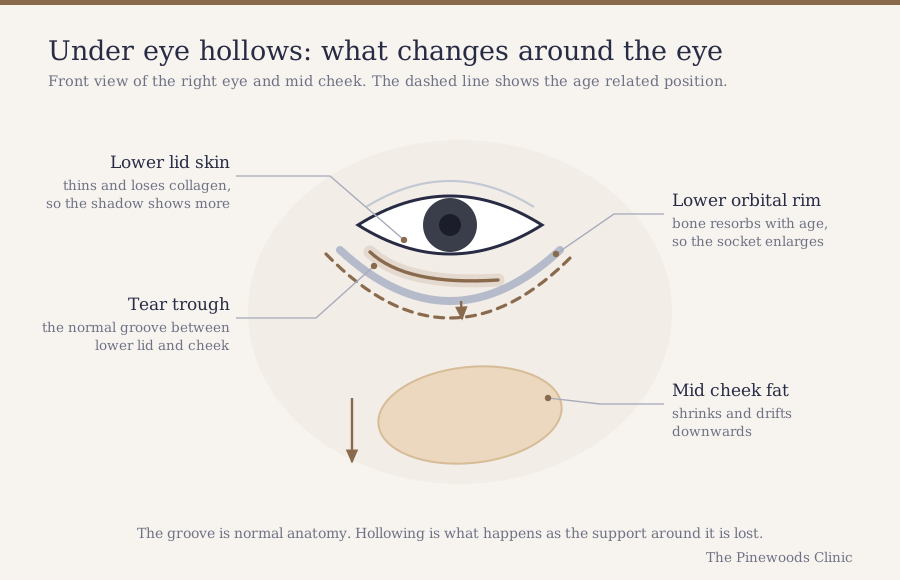
Fat is lost and repositioned. The face is built in compartments of fat, and the ones supporting the mid cheek both shrink and drift downwards over time. As the cheek descends, the tear trough is left exposed at its upper edge, and the transition from lid to cheek becomes a step rather than a curve.
The bone changes shape. This is the least known and one of the more important. The eye socket does not stay fixed. The lower orbital rim resorbs with age, particularly at the inner corner, so the socket enlarges and the soft tissue has more space to cover. The groove deepens as a result, regardless of what the fat above it is doing.
The skin thins and loses collagen. Under eye skin is the thinnest on the face to begin with. As collagen declines it becomes more translucent, which makes the shadow more visible and can let the bluish tone of underlying vessels show through.
The supporting ligaments loosen. The tissue anchoring the lid to the bone slackens, so the boundary between lid and cheek becomes more pronounced rather than blending.
These changes act together rather than in sequence, which is why the effect is often larger than any one of them would suggest. A cheek that has descended slightly exposes a groove that has also deepened as the orbital rim has resorbed, beneath skin that has thinned enough to show the shadow more clearly. Treating one element in isolation frequently under-delivers for that reason, and it is why assessment looks at the mid cheek and the orbital rim rather than the lower lid alone.
Why Do Some People Get Under Eye Hollows In Their Twenties?
Because the tear trough is inherited before it is aged into.
Some people are built with a shallower orbital rim, a flatter mid cheek, or thinner lower lid skin than average. In those faces the groove is visible from early adulthood, and it is a structural feature rather than a sign of anything going wrong. If your parents or siblings have the same shadow, that is almost always the explanation.
There is a practical consequence. Hollows present from the twenties are structural and stable, and they do not respond to sleep, hydration or skincare, because nothing has been lost. Hollows that appear later are progressive, and the causes above continue to act.
Does Tiredness Cause Under Eye Hollows?
Tiredness does not cause under eye hollows, but it does make them more noticeable.
Poor sleep, dehydration, alcohol and salt all affect fluid balance and circulation around the eye, and all of them change how the area looks on a given morning. What they do not do is create the groove or deepen it. Someone with no structural hollowing will not develop one from a bad week, and someone with an established hollow will still have it after a good night's sleep.
This distinction matters practically. If the shadow varies noticeably from day to day, fluid and circulation are contributing and lifestyle measures will help. If it looks the same every morning, the cause is structural and no amount of water will change it.
What Makes Hollowing Under The Eyes Worse?
Three things accelerate the underlying process rather than just affecting appearance.
Sun exposure breaks down collagen in skin that is already the thinnest on the face, and it also drives pigmentation, which darkens the area independently of the shadow.
Smoking accelerates collagen breakdown and reduces the skin's elasticity and support.
Significant weight loss removes facial fat along with body fat. The face carries very little to spare, and the area around the eye is among the first places it shows. Rapid loss shows more than gradual loss, because the skin has less opportunity to adapt.
Can You Prevent Hollowing Under The Eyes?
Partly. The structural changes are not preventable, but the rate is influenced.
Daily sun protection is the single most useful measure, because it addresses both collagen loss and pigmentation. Not smoking matters for the same reason. Losing weight gradually rather than rapidly gives the skin time to accommodate the change. Consistent sleep and hydration will not prevent hollowing, but they stop it looking worse than it is.
What will not prevent it is any topical product claiming to restore volume. The groove sits beneath the skin, at a depth no cream reaches. Skincare improves the surface over the hollow, which is worth doing, and it does not fill it. Where hollowing is already established it can be treated, either by restoring volume or, where the underlying cause is a fat pad rather than lost volume, by eyelid surgery.
Is It A Hollow Or An Eye Bag?
Not every dark or tired under eye is a hollow, and the distinction changes what helps.
A permanent bag is fat that has moved forward through a weakened barrier in the lower lid. It sits proud of the skin and casts its own shadow, which can read as a hollow while being the opposite problem. Pigmentation is colour in the skin rather than shape, and it stays visible when the skin is gently stretched. Fluid retention changes through the day and with sleep.
Our guide to removing under eye bags permanently sets out how to tell them apart and what treatment applies to each.
Under Eye Hollows Assessment In Liverpool
Assessment of under eye hollows at The Pinewoods Clinic is carried out by a consultant, who examines the lower lid, the orbital rim and the mid cheek to establish what is producing the shadow, and whether the cause is volume, fat position, skin quality or pigment. Because the clinic offers both surgical and non-surgical treatment of the eye area, the assessment is not tied to a single outcome, and includes being clear where no treatment is warranted.
The clinic is at Burlington House on Crosby Road North in Waterloo, and sees patients from across Liverpool, Sefton, the Wirral and Cheshire. You can see the full range of treatments available, or contact us to arrange a consultation.
Frequently Asked Questions
Are Under Eye Hollows Genetic?
Often, particularly where they are visible before the age of thirty. Inherited orbital shape, mid cheek projection and skin thickness all determine how prominent the tear trough is, which is why hollows frequently run in families and appear in people who are otherwise young and well rested.
Do Under Eye Hollows Get Deeper Over Time?
Age related hollows generally progress, because fat loss, bone resorption and collagen decline continue. Genetic hollows present from early adulthood tend to be more stable, though the age related changes are added to them later.
Can Eye Cream Fix Under Eye Hollows?
No. The groove lies beneath the skin at a depth topical products do not reach. A good eye product hydrates and helps maintain skin thickness over the area, which can make the shadow slightly less obvious, but it does not restore lost volume.
Why Do My Under Eye Hollows Look Worse In Photos?
Overhead and front-facing light casts a shadow directly into the groove, which exaggerates the depth. The same hollow can look mild in soft or side lighting and pronounced under a flash, which is why photographs are an unreliable way to judge how noticeable it actually is.