

Removal of Cyst (face) £550
Removal of Cyst (body) £500
Removal of cyst body (large) £600
Additional cysts £300

Cyst Removal at The Pinewoods Clinic, Liverpool At The Pinewoods Clinic, our experienced dermatologists and surgeons provide safe, precise cyst removal for cosmetic or medical reasons. Using advanced minimally invasive techniques, we ensure minimal scarring and fast healing, with personalised care for every patient.

Upper Blepharoplasty - From £3000
Upper Blepharoplasty with Browpexy - From £3300
LA Pinch Lower Blepharoplasty - From £3000
Lower Blepharoplasty with Sedation - From £5600
Upper and Lower Blepharoplasty - From £7000
Upper and Lower Blepharoplasty (GA) - Priced on assessment
Your exact price is confirmed in writing after your consultation.
Dermal cysts are common, benign lumps that can appear anywhere on the skin. While usually harmless, they may become painful, infected, or cosmetically concerning. At The Pinewoods Clinic, our experienced dermatologists and surgeons provide expert dermal cyst removal, using minimally invasive techniques to ensure safe, effective treatment with excellent cosmetic results.
A dermal cyst is a sac-like structure under the skin, often filled with fluid, keratin, or other tissue. Common types include epidermoid cysts and pilar cysts, which typically grow slowly and are painless unless inflamed or infected.
Patients choose cyst removal for several reasons:
At The Pinewoods Clinic, we use minimally invasive surgical techniques to remove cysts safely while minimising scarring:
If you have a dermal cyst causing discomfort or concern, contact The Pinewoods Clinic in Liverpool today. Our expert team will assess your condition and recommend the safest and most effective cyst removal method for long-lasting results.
Upper blepharoplasty treats the skin above the eye. Lower blepharoplasty treats bags, puffiness and loose skin below it. They are different procedures with different recovery patterns, and many patients need only one.
If your concern is a heavy or hooded upper lid, the upper procedure is the relevant one. If it is bags or shadowing beneath the eye, the lower procedure is. Where both are appropriate they can be carried out together, and your surgeon will advise whether treating them at the same time or separately suits your case.
Three different problems are often confused with each other. Skin sitting heavy on the upper lid is usually treated with upper blepharoplasty, unless the cause is brow descent, in which case a brow lift or browpexy is the answer. Puffiness under the eye that changes through the day is fluid, and no procedure will remove it. A permanent bag beneath the eye is fat, and lower blepharoplasty is the only thing that takes it away. Crepey skin and fine lines around the eye respond to laser resurfacing rather than surgery.
Blepharoplasty at The Pinewoods Clinic starts from £3,000.
Upper and lower blepharoplasty under general anaesthetic is priced on assessment. Your exact price is confirmed in writing after your consultation.
Four things move the figure. Whether the upper lid, the lower lid, or both are treated. Whether a supporting procedure such as browpexy or canthopexy is added. The anaesthetic appropriate to your case, since lower lid surgery under sedation costs more than a procedure under local anaesthetic. And the amount of skin to be removed, and whether muscle or fat also needs addressing, which varies between patients.
Upper blepharoplasty, sometimes called an upper bleph, removes excess skin from the upper eyelid to lift a heavy or hooded lid and open the eye area.
It suits adults whose upper lids carry enough excess skin to create heaviness, hooding, or interference with vision. The signs are practical rather than dramatic. Eyeshadow transfers onto the lid within an hour. The lid space has narrowed enough that eyeliner is difficult to place. Reading for long periods leaves the forehead aching, because the brow is working to hold the lid clear. And people ask whether you are tired when you are not.
Where the excess skin sits low enough to obstruct the upper field of vision, the procedure is functional as well as cosmetic. Your surgeon will assess this at consultation.
It is not the right procedure for everyone with a heavy lid. In some patients the cause is the position of the brow rather than the eyelid itself. As the brow descends with age it pushes skin down onto the lid, and treating the lid alone will not resolve it. Where that is the case, a brow lift or a browpexy may be recommended instead of, or alongside, eyelid surgery.
Lower blepharoplasty is the surgical treatment for under eye bags. It addresses the fat pad that creates a permanent bag beneath the eye, along with loose or creased skin and the hollow that can form between the lid and the cheek.
Not all under eye bags are surgical. Puffiness that is worse in the morning, or that changes with sleep, salt or alcohol, is fluid, and surgery will not change it. A true eye bag is fat that has moved forward through a weakened barrier in the lower lid, and it is the only version that responds to surgery. The consultation establishes which you have.
Lower eyelid surgery can be performed through an incision just beneath the lash line, or from inside the lid where no external incision is needed. Which approach is appropriate depends on whether skin as well as fat needs to be addressed.
Upper & lower blepharoplasty before and after at The Pinewoods Clinic Liverpool
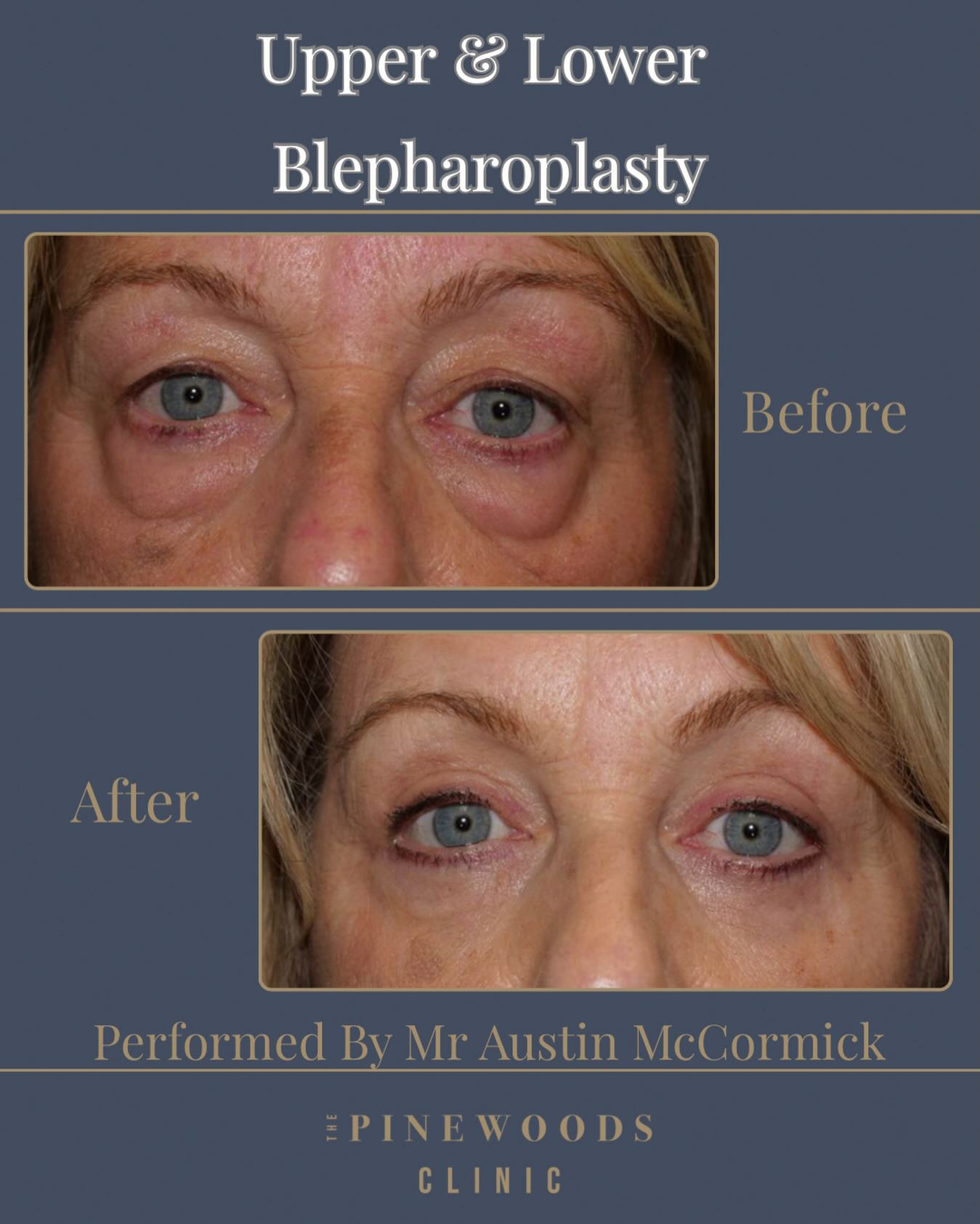
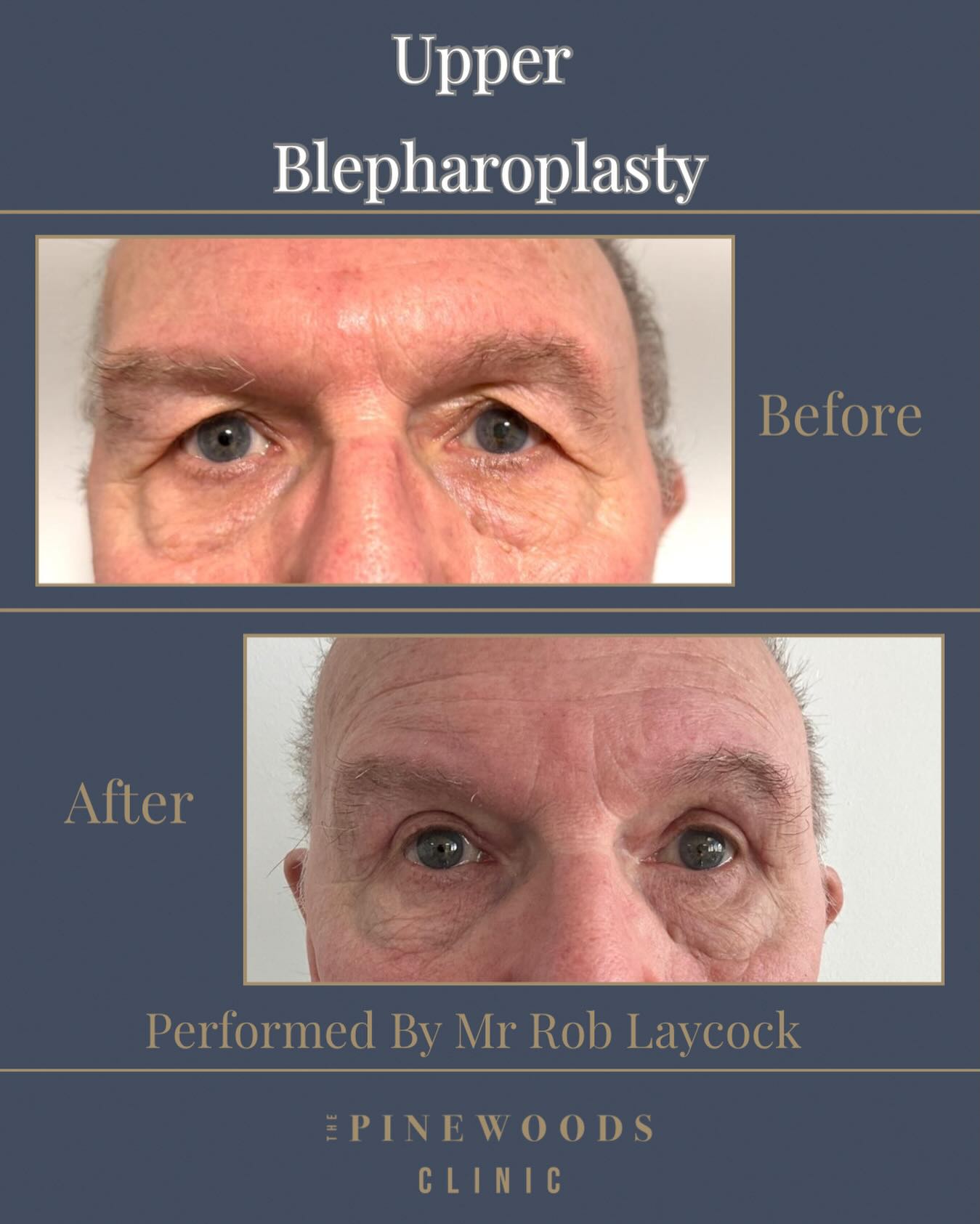
Results vary between patients, and what is achievable in your case is assessed at consultation.
Browpexy lifts and stabilises the outer part of the eyebrow and can be carried out through the same incision as upper eyelid surgery. It suits patients with mild to moderate brow descent, where lifting the brow slightly improves the result and means less eyelid skin needs to be removed.
Canthopexy tightens and supports the outer corner of the eye, where the upper and lower lids meet. At The Pinewoods Clinic it is usually combined with lower blepharoplasty, both to improve the result and to support the lid position afterwards.
Neither adds a separate scar or a separate recovery period when carried out alongside eyelid surgery.
£118 per 3 treatments
£162 per 3 treatments
£162 per 3 treatments
£162 per 3 treatments
£205 per 3 treatments
£259 per 3 treatments
£324 per 3 treatments
£205 per 3 treatments
£259 per 3 treatments
£216 per 3 treatments
£324 per 3 treatments
£378 per 3 treatments
£205 per 3 treatments
£378 per 3 treatments
£432 per 3 treatments
£540 per 3 treatments
£324 per 3 treatments
£378 per 3 treatments
£378 per 3 treatments
£378 per 3 treatments
£540 per 3 treatments
£853 per 3 treatments
£1,080 per 3 treatments
£540 per 3 treatments
£853 per 3 treatments
£378 per 3 treatments
£432 per 3 treatments
£540 per 3 treatments
£324 per 3 treatments
£540 per 3 treatments
£853 per 3 treatments
£1,080 per 3 treatments
The surgery usually takes less than 30 minutes but may take longer if multiple cysts are being removed.
Most people can return to their normal activities within a few days. However, it is important to avoid strenuous activity or contact sports for at least 2 weeks to allow the incision to heal properly.
In most cases, the incision will heal with minimal scarring. However, this will depend on the size and location of the incision as well as your own healing ability.
As with any surgery, there are some risks associated with cyst removal. These include infection, bleeding, and scarring. However, these complications are rare and most people experience no problems after surgery.