90 mins

From £3000 under LA
From Tricophytic (Hairline) Browlift £4000 with Deep Sedation

10-14 days
Brow Lift Surgery – Restore a Youthful, Refreshed Appearance Enhance your natural beauty with brow lift surgery — a safe and effective cosmetic procedure that lifts and repositions the eyebrows for a smoother, more youthful look. A forehead lift can reduce frown lines, correct drooping brows, and open up the eye area for a refreshed appearance. At our clinic, experienced surgeons provide customised brow lift treatments using advanced techniques for natural, long-lasting results. Book your brow lift consultation today to discover how a forehead lift can rejuvenate your face and boost your confidence.

Upper Blepharoplasty - From £3000
Upper Blepharoplasty with Browpexy - From £3300
LA Pinch Lower Blepharoplasty - From £3000
Lower Blepharoplasty with Sedation - From £5600
Upper and Lower Blepharoplasty - From £7000
Upper and Lower Blepharoplasty (GA) - Priced on assessment
Your exact price is confirmed in writing after your consultation.
As we age the brow becomes lax and descends. This can lead to a heaviness of the eyebrow and a flat appearance. When the brow drops the eyelids can appear hooded and have excess skin. Many patients attend with concerns over their eyelids and the cause ultimately is the brow position.
The flattening and descent of the brow is caused by the skin losing its elasticity as part of the natural ageing process. The patient is left with a more youthful-looking brow after treatment.
There are multiple surgical techniques which can be used in an eyebrow lift. These techniques usually involve the removal of excess facial skin. Depending on which method is used, the surgeon may also tighten the underlying tissues before redraping the skin. Your surgeon will discuss with you which technique would be best to meet your needs at your initial consultation here at the clinic.
An eyebrow lift is an excellent way to slow down the aging process. Surgery treats common age-related complaints, such as a low, sagging brow or brow asymmetry. Although a brow lift primarily deals with cosmetic concerns, it can also help with brow drooping (also known as brow ptosis) caused by illness or injury, for example, nerve damage in the face.
In some cases, brow drooping can cause physical discomfort. People with significant brow ptosis may find they suffer from headaches as their forehead muscles have to work extra hard to lift their drooping eyebrows. In some cases, drooping brows can obscure vision.
Brow lift surgery will return the brow to its original position and improve vision if this has been affected by a drooping brow
A brow lift is commonly combined with other rejuvenating facial procedures, such as eyelid surgery (blepharoplasty) or a face lift to enhance the overall result.
A brow lift improves the appearance of the forehead, the brow and the area around the eyes by raising the soft tissue and skin of the forehead and brow. Some patients opt to undergo fat grafting alongside their brow lift. This procedure lifts and adds volume to the brow and the temple, providing an enhanced, permanent, structure to support the skin on the forehead.
There are also non-surgical eyebrow lift procedures that we carry out here at the Pinewoods Clinic.
Both surgical and non surgical eyebrow lift treatments aim to:
Pinewoods Clinic considers individuals fit for the procedure, if all of the following are true of them:
Brow lift surgery usually takes around one to two hours, depending on which technique is being used. This may take longer if other procedures are carried out at the same time. Eyebrow lift surgery is carried out under a general anesthetic. This means you will not be awake during the procedure.
There are several different eyebrow lift techniques which we use here at the Pinewoods Clinic. Your surgeon will decide which type is best for you depending on your individual needs and what you hope to achieve with surgery. We will look at these different surgical techniques here.
This particular technique is minimally invasive. In an endoscopic brow lift, the surgeon makes incisions behind the hairline and a thin camera (endoscope) is used to view your underlying muscles and tissues. The forehead tissues are lifted and a special medical instrument is put in place to anchor these in an elevated position, lifting the brow. After three to six months, these will be safely reabsorbed back into the body, leaving the brow in its new lifted position.
In a coronal brow lift, an incision is made behind the hairline, traveling across the top of the head, from ear to ear. The surgeon will then lift the skin tissue to an elevated position, cutting away and removing any excess tissue. This particular technique can rejuvenate the upper portion of the face. Although, like all the brow lift techniques, it can be carried out on both men and women, this particular method is more popular among women. This method can leave some scarring, but this is hidden in the hairline. For this reason, the coronal brow lift is not generally favoured by those with a receding hairline.
In a hairline brow lift, the surgeon will make an incision between the top of the forehead and the beginning of the hairline. A small amount of skin and tissue is then removed from the top of the forehead, rather than from the scalp itself. This means the hairline itself is not pulled back in this particular technique. The hairline brow lift is a popular choice for patients who have a receding hairline and are experiencing deep forehead lines.
This particular eyebrow lift is a good choice for patients who only require a moderate lift of the outer brow. This is the first part of the brow to descend down the face as we age. Two small incisions are made in the temples within the hairline. A strip of skin is then removed. This particular method is good for tackling problem crow’s feet, noticeable wrinkles which develop around the outer corners of the eyes. Patients often chose to combine a temporal brow lift with blepharoplasty to enhance the result. A temporal brow lift is also known as a lateral brow lift.
A non-surgical brow lift, as the name suggests, is a form of eyebrow lift which does not require any incisions or anesthetic. This type of treatment can produce some dramatic results, but these are not as long-lasting as a surgical brow lift. There are two popular non-surgical eyebrow lift treatments that we offer here at The Pinewoods Clinic
Anti-ageing injectables are muscle relaxants and are used to smooth out fine lines and wrinkles. The most common anti-aging injectable which you may have heard of is Botox. The injectable is introduced to the brow and effectively reduces lines and wrinkles while simultaneously reducing the pull of the muscles which cause the eyebrow to descend.
The treatment is an easy and relatively pain free process. Anti-aging injectables are also commonly used in the eye and cheek areas.
The procedure is carried out during a 30-minute consultation and involves a series of tiny injections to the brow area. There is no downtime involved with anti-aging injectables, meaning you are free to leave the clinic after your treatment and return to your day-to-day activities.
As part of this non-surgical brow lift, fillers can be used to plump out the treatment area, providing additional volume, if desired. Dermal fillers are quick injectable treatments that can soften facial wrinkles and lines and fill out hollows, leaving the skin looking younger.
It is unlikely that you will experience complications stemming from your brow lift. Our expert surgeons have performed this surgery many, many times, and all have a high satisfaction rating. However, as with any surgery, there is always the potential for complications. Risks from eyebrow lift surgery include:
In addition to this, any type of surgery carries a small risk of:
On very rare occasions, the patient may require a revision procedure if the result is not as expected. It is important you are honest with your surgeon at your initial consultation to help avoid this situation occurring. During this first consultation the surgeon will go through all the potential risks with you before you decide whether to go ahead with surgery.
If you experience chest pain, shortness of breath or irregular heartbeats following surgery you should seek medical advice immediately. This may be a medical emergency.
Patients often request for a brow lift and blepharoplasty (eyelid surgery) to be carried out together in order to achieve an enhanced result.
Eyelid reduction surgery reshapes the eyelids by removing excess fat and skin. Just like an eyebrow lift, blepharoplasty is a highly effective treatment for the signs of aging around this upper portion of the face.
The skin around the eyes is very thin, so, combined with skin laxity caused by an age-related drop in collagen levels, this means the skin around the eyes is more prone to wrinkles, including crow’s feet, or laughter lines, at the corners of the eyes. Combined with a sagging brow, this means the wide-eyed appearance of youth is lost. This age-related descent can also cause tear troughs or hollows to appear underneath the eyes.
Blepharoplasty is a short and highly effective procedure that can achieve immediate changes with very little downtime. Blepharoplasty is best suited for cases where major surgical intervention is required. Alternatively, anti-aging injectables can be used to tackle wrinkles and fine lines around the eyes.
You will be allowed to return home on the same day as surgery to allow yourself to rest and recuperate in the comfort of your own home. Your surgeon will give you specific instructions on how to care for your incisions. It is important that you follow these to help aid your recovery. In the days following your brow lift, you should rest with your head elevated and avoid exposing the incision sites to excessive pressure or movement.
You may experience some itching and numbness around the incision sites as you heal. This should stop over time. The treatment site is likely to be bruised, swollen and tender in the days after brow lift surgery. Swelling may last for several weeks, but this can be treated with a cold compress and sleeping with multiple pillows may also help. A compression garment will also help to reduce swelling.
Any bandages will be removed within three days post-surgery and non-dissolvable sutures are usually removed within seven to ten days.
We advise taking two weeks off work and avoiding strenuous exercise for up to six weeks following surgery. Any heavy lifting should also be avoided. You should take care when washing your hair and bathing in the days and weeks following brow lift surgery. It is important that you do not get the dressing wet in order to avoid any infection.
Any scars left from the incisions should fade naturally over time.
Upper blepharoplasty treats the skin above the eye. Lower blepharoplasty treats bags, puffiness and loose skin below it. They are different procedures with different recovery patterns, and many patients need only one.
If your concern is a heavy or hooded upper lid, the upper procedure is the relevant one. If it is bags or shadowing beneath the eye, the lower procedure is. Where both are appropriate they can be carried out together, and your surgeon will advise whether treating them at the same time or separately suits your case.
Three different problems are often confused with each other. Skin sitting heavy on the upper lid is usually treated with upper blepharoplasty, unless the cause is brow descent, in which case a brow lift or browpexy is the answer. Puffiness under the eye that changes through the day is fluid, and no procedure will remove it. A permanent bag beneath the eye is fat, and lower blepharoplasty is the only thing that takes it away. Crepey skin and fine lines around the eye respond to laser resurfacing rather than surgery.
Blepharoplasty at The Pinewoods Clinic starts from £3,000.
Upper and lower blepharoplasty under general anaesthetic is priced on assessment. Your exact price is confirmed in writing after your consultation.
Four things move the figure. Whether the upper lid, the lower lid, or both are treated. Whether a supporting procedure such as browpexy or canthopexy is added. The anaesthetic appropriate to your case, since lower lid surgery under sedation costs more than a procedure under local anaesthetic. And the amount of skin to be removed, and whether muscle or fat also needs addressing, which varies between patients.
Upper blepharoplasty, sometimes called an upper bleph, removes excess skin from the upper eyelid to lift a heavy or hooded lid and open the eye area.
It suits adults whose upper lids carry enough excess skin to create heaviness, hooding, or interference with vision. The signs are practical rather than dramatic. Eyeshadow transfers onto the lid within an hour. The lid space has narrowed enough that eyeliner is difficult to place. Reading for long periods leaves the forehead aching, because the brow is working to hold the lid clear. And people ask whether you are tired when you are not.
Where the excess skin sits low enough to obstruct the upper field of vision, the procedure is functional as well as cosmetic. Your surgeon will assess this at consultation.
It is not the right procedure for everyone with a heavy lid. In some patients the cause is the position of the brow rather than the eyelid itself. As the brow descends with age it pushes skin down onto the lid, and treating the lid alone will not resolve it. Where that is the case, a brow lift or a browpexy may be recommended instead of, or alongside, eyelid surgery.
Lower blepharoplasty is the surgical treatment for under eye bags. It addresses the fat pad that creates a permanent bag beneath the eye, along with loose or creased skin and the hollow that can form between the lid and the cheek.
Not all under eye bags are surgical. Puffiness that is worse in the morning, or that changes with sleep, salt or alcohol, is fluid, and surgery will not change it. A true eye bag is fat that has moved forward through a weakened barrier in the lower lid, and it is the only version that responds to surgery. The consultation establishes which you have.
Lower eyelid surgery can be performed through an incision just beneath the lash line, or from inside the lid where no external incision is needed. Which approach is appropriate depends on whether skin as well as fat needs to be addressed.
Upper & lower blepharoplasty before and after at The Pinewoods Clinic Liverpool
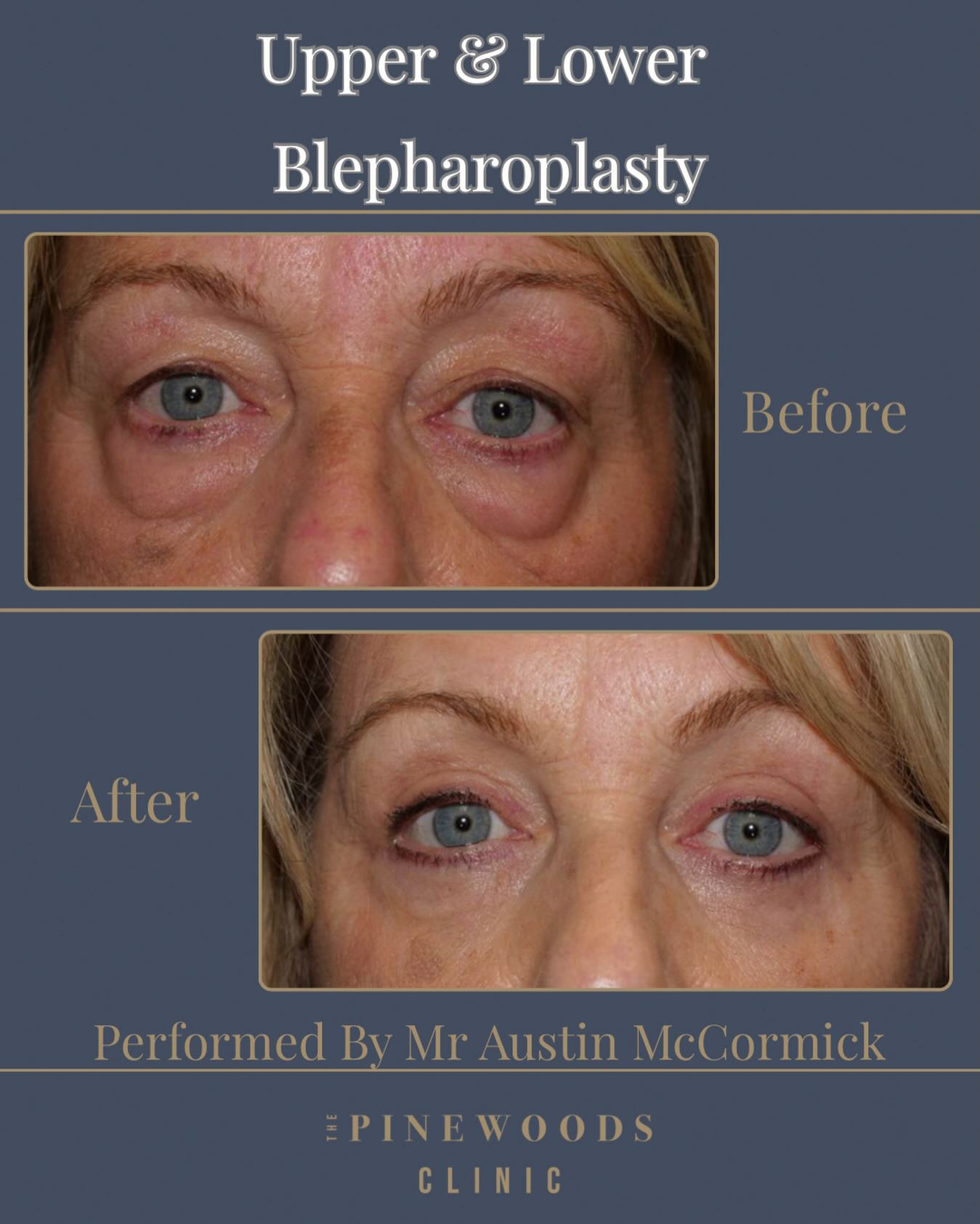
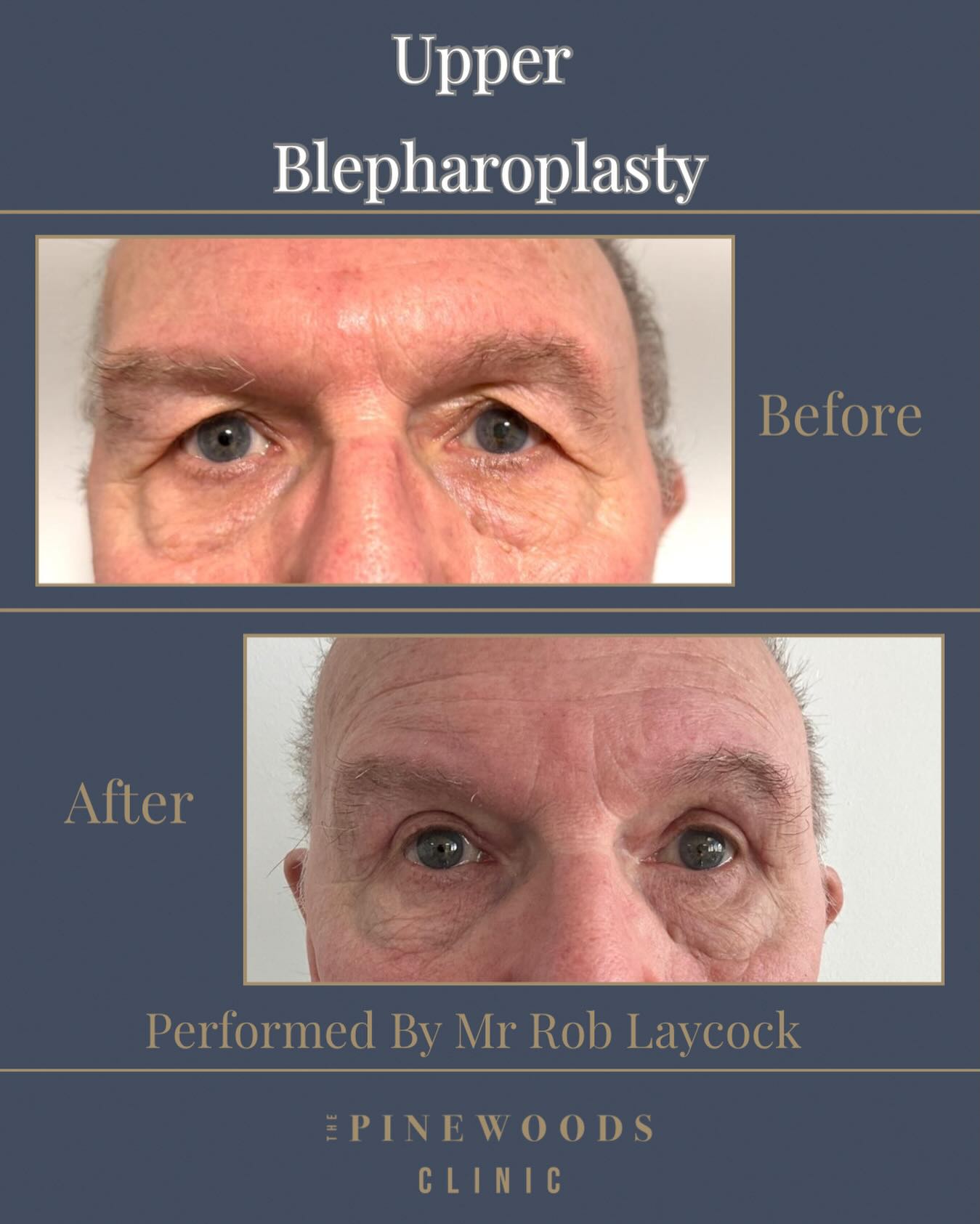
Results vary between patients, and what is achievable in your case is assessed at consultation.
Browpexy lifts and stabilises the outer part of the eyebrow and can be carried out through the same incision as upper eyelid surgery. It suits patients with mild to moderate brow descent, where lifting the brow slightly improves the result and means less eyelid skin needs to be removed.
Canthopexy tightens and supports the outer corner of the eye, where the upper and lower lids meet. At The Pinewoods Clinic it is usually combined with lower blepharoplasty, both to improve the result and to support the lid position afterwards.
Neither adds a separate scar or a separate recovery period when carried out alongside eyelid surgery.
£118 per 3 treatments
£162 per 3 treatments
£162 per 3 treatments
£162 per 3 treatments
£205 per 3 treatments
£259 per 3 treatments
£324 per 3 treatments
£205 per 3 treatments
£259 per 3 treatments
£216 per 3 treatments
£324 per 3 treatments
£378 per 3 treatments
£205 per 3 treatments
£378 per 3 treatments
£432 per 3 treatments
£540 per 3 treatments
£324 per 3 treatments
£378 per 3 treatments
£378 per 3 treatments
£378 per 3 treatments
£540 per 3 treatments
£853 per 3 treatments
£1,080 per 3 treatments
£540 per 3 treatments
£853 per 3 treatments
£378 per 3 treatments
£432 per 3 treatments
£540 per 3 treatments
£324 per 3 treatments
£540 per 3 treatments
£853 per 3 treatments
£1,080 per 3 treatments