1 hour
Adult Initial Assessment 1 Hour: £675
Child Initial Assessment 1 Hour: £ 1250
Titration Appointments: £225
Adult Follow up Appointment: £225
Child Follow up Appointment: £265
ECG: £100
Shared Care Referral: £100

ADHD Clinic in the North West – Specialist Care in Liverpool Our ADHD clinic provides expert assessment, diagnosis, and treatment for children and families across the North West, including Liverpool and surrounding areas. We offer personalised care plans, behavioural therapy, parent support, and medication management to help children with ADHD focus, learn, and thrive. Book an ADHD assessment in Liverpool today and get compassionate support from experienced specialists.

Upper Blepharoplasty - From £3000
Upper Blepharoplasty with Browpexy - From £3300
LA Pinch Lower Blepharoplasty - From £3000
Lower Blepharoplasty with Sedation - From £5600
Upper and Lower Blepharoplasty - From £7000
Upper and Lower Blepharoplasty (GA) - Priced on assessment
Your exact price is confirmed in writing after your consultation.
Attention-Deficit/Hyperactivity Disorder (ADHD) is a common neurodevelopmental condition that affects how a person focuses, controls impulses, and manages energy levels. It often begins in childhood and can continue into adulthood. People with ADHD may find it hard to pay attention, sit still, or complete tasks — but with the right support and treatment, they can thrive in school, work, and daily life.
ADHD presents differently from person to person. Some people struggle more with attention and organisation (sometimes called predominantly inattentive type), while others are more active and impulsive (predominantly hyperactive-impulsive type). Many experience a mix of both.
Common symptoms include:
This can include behavioural strategies, therapy, lifestyle changes, and sometimes medication. Working with a healthcare professional can help you find the approach that best fits your needs and goals.
Understanding ADHD in Children
Attention-Deficit/Hyperactivity Disorder (ADHD) is a common condition that affects how children focus, think, and manage their behaviour. It’s not caused by bad parenting or a lack of discipline — it’s a neurodevelopmental condition, meaning the brain works a little differently in areas that control attention, activity level, and impulse control.
Children with ADHD may struggle to sit still, pay attention, follow instructions, or finish tasks — especially in settings like school or homework time. These challenges can be frustrating for both children and parents, but with understanding and the right support, children with ADHD can learn strategies to succeed and feel confident.
Common signs of ADHD in children include:
How parents can help:
Remember, ADHD does not define your child. With the right understanding, support, and care, children with ADHD can develop their strengths, build confidence, and reach their full potential.
Once your booking is confirmed, your specialist may send you the several pre-assessment forms. You'll need to fill out some prior to the appointment. Please complete these at least 24 hours before your appointment to give your specialist time to review them. Please note that the assessment cannot proceed unless both forms are received on time.
Your assessment lasts between 90 and 120 minutes. First, you'll typically discuss your background—including your biographical and medical history—followed by a structured clinical interview using a validated assessment tool. During this time, you'll have the opportunity to share your concerns and experiences.
If you're diagnosed with ADHD, your specialist will confirm this verbally during the appointment and provide a detailed diagnostic report afterwards.
Remember: a diagnosis is not guaranteed—this is an objective clinical assessment based on your individual case.
If you receive a diagnosis, your specialist will discuss treatment options with you. These options may include:
If you choose to pursue medication, your specialist will explain the different types so you can make an informed decision. You can arrange a 30-minute titration appointment to discuss further details about medication and treatment.
During the titration appointment, your specialist will need some basic health information—your pulse rate, blood pressure, height, and weight. In some cases, if there is a family history of heart conditions, you may need a letter from a cardiologist or another medical professional. You can get your pulse rate and blood pressure checked at your GP or local pharmacy. The cost of the medication, delivery, and dispensing fee will be explained during your appointment.
Once your specialist starts prescribing medication, they will monitor you with follow-up appointments over the next three months. This titration window is crucial to optimise your dosage. After this titration period, you can request a Shared Care Protocol.
You will receive a detailed report after your assessment, which includes your diagnosis (if any). This letter will be provided typically within a week of your assessment and this full report will be with you between 2-4 weeks after your assessment. This report will include your detailed assessment outcome and suggested treatment plan options.
Please note, the treatment process can begin before you receive your report, so your specialist can prescribe medication soon after the assessment.
After your assessment, you can book follow-ups with our ADHD specialist, as well as sessions with additional mental health professionals and coaching. You can also join a community offering classes, workshops, and educational content on neurodiversity—all designed to support you every step of the way.
Booking your assessment is simple, either:
Upper blepharoplasty treats the skin above the eye. Lower blepharoplasty treats bags, puffiness and loose skin below it. They are different procedures with different recovery patterns, and many patients need only one.
If your concern is a heavy or hooded upper lid, the upper procedure is the relevant one. If it is bags or shadowing beneath the eye, the lower procedure is. Where both are appropriate they can be carried out together, and your surgeon will advise whether treating them at the same time or separately suits your case.
Three different problems are often confused with each other. Skin sitting heavy on the upper lid is usually treated with upper blepharoplasty, unless the cause is brow descent, in which case a brow lift or browpexy is the answer. Puffiness under the eye that changes through the day is fluid, and no procedure will remove it. A permanent bag beneath the eye is fat, and lower blepharoplasty is the only thing that takes it away. Crepey skin and fine lines around the eye respond to laser resurfacing rather than surgery.
Blepharoplasty at The Pinewoods Clinic starts from £3,000.
Upper and lower blepharoplasty under general anaesthetic is priced on assessment. Your exact price is confirmed in writing after your consultation.
Four things move the figure. Whether the upper lid, the lower lid, or both are treated. Whether a supporting procedure such as browpexy or canthopexy is added. The anaesthetic appropriate to your case, since lower lid surgery under sedation costs more than a procedure under local anaesthetic. And the amount of skin to be removed, and whether muscle or fat also needs addressing, which varies between patients.
Upper blepharoplasty, sometimes called an upper bleph, removes excess skin from the upper eyelid to lift a heavy or hooded lid and open the eye area.
It suits adults whose upper lids carry enough excess skin to create heaviness, hooding, or interference with vision. The signs are practical rather than dramatic. Eyeshadow transfers onto the lid within an hour. The lid space has narrowed enough that eyeliner is difficult to place. Reading for long periods leaves the forehead aching, because the brow is working to hold the lid clear. And people ask whether you are tired when you are not.
Where the excess skin sits low enough to obstruct the upper field of vision, the procedure is functional as well as cosmetic. Your surgeon will assess this at consultation.
It is not the right procedure for everyone with a heavy lid. In some patients the cause is the position of the brow rather than the eyelid itself. As the brow descends with age it pushes skin down onto the lid, and treating the lid alone will not resolve it. Where that is the case, a brow lift or a browpexy may be recommended instead of, or alongside, eyelid surgery.
Lower blepharoplasty is the surgical treatment for under eye bags. It addresses the fat pad that creates a permanent bag beneath the eye, along with loose or creased skin and the hollow that can form between the lid and the cheek.
Not all under eye bags are surgical. Puffiness that is worse in the morning, or that changes with sleep, salt or alcohol, is fluid, and surgery will not change it. A true eye bag is fat that has moved forward through a weakened barrier in the lower lid, and it is the only version that responds to surgery. The consultation establishes which you have.
Lower eyelid surgery can be performed through an incision just beneath the lash line, or from inside the lid where no external incision is needed. Which approach is appropriate depends on whether skin as well as fat needs to be addressed.
Upper & lower blepharoplasty before and after at The Pinewoods Clinic Liverpool
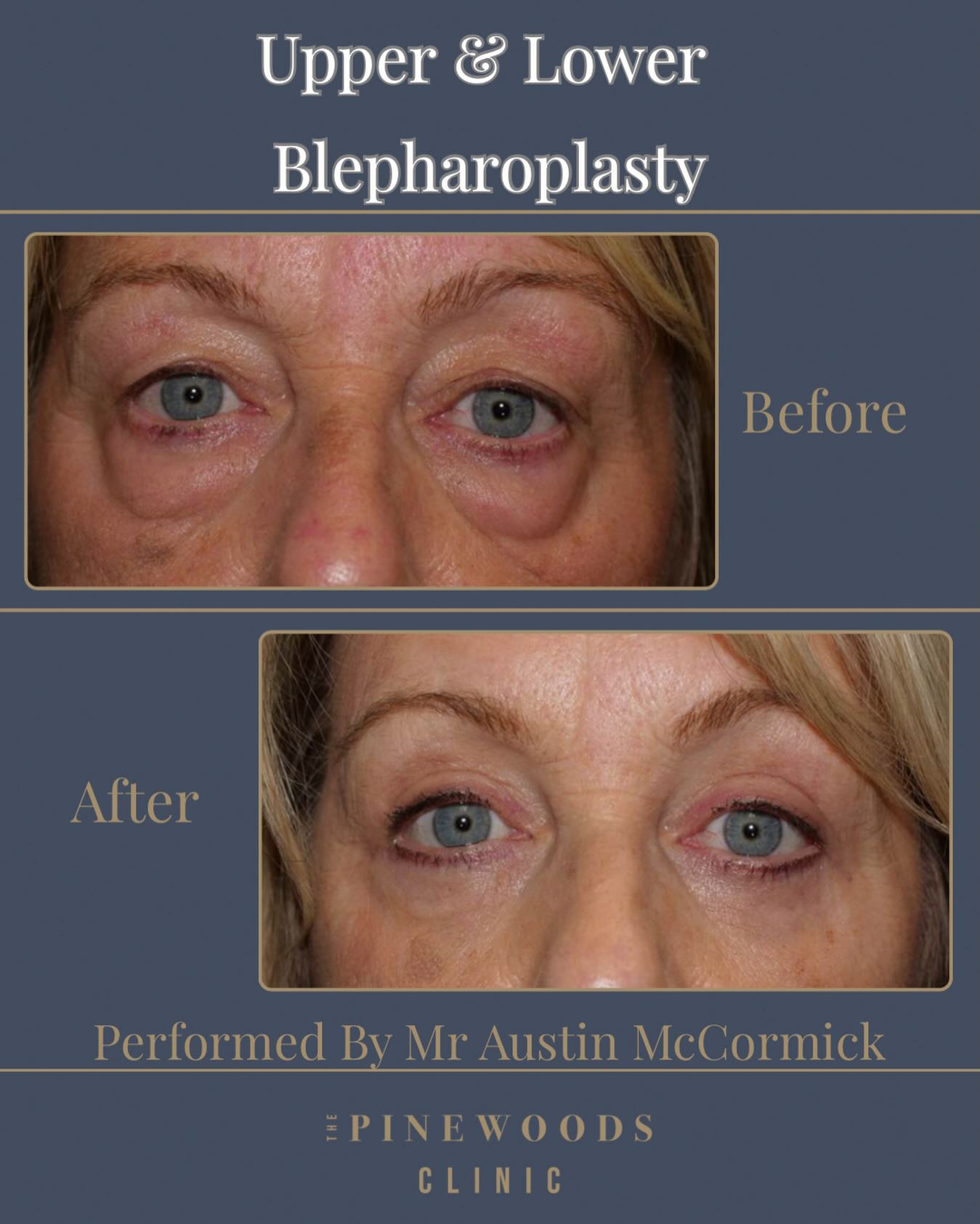
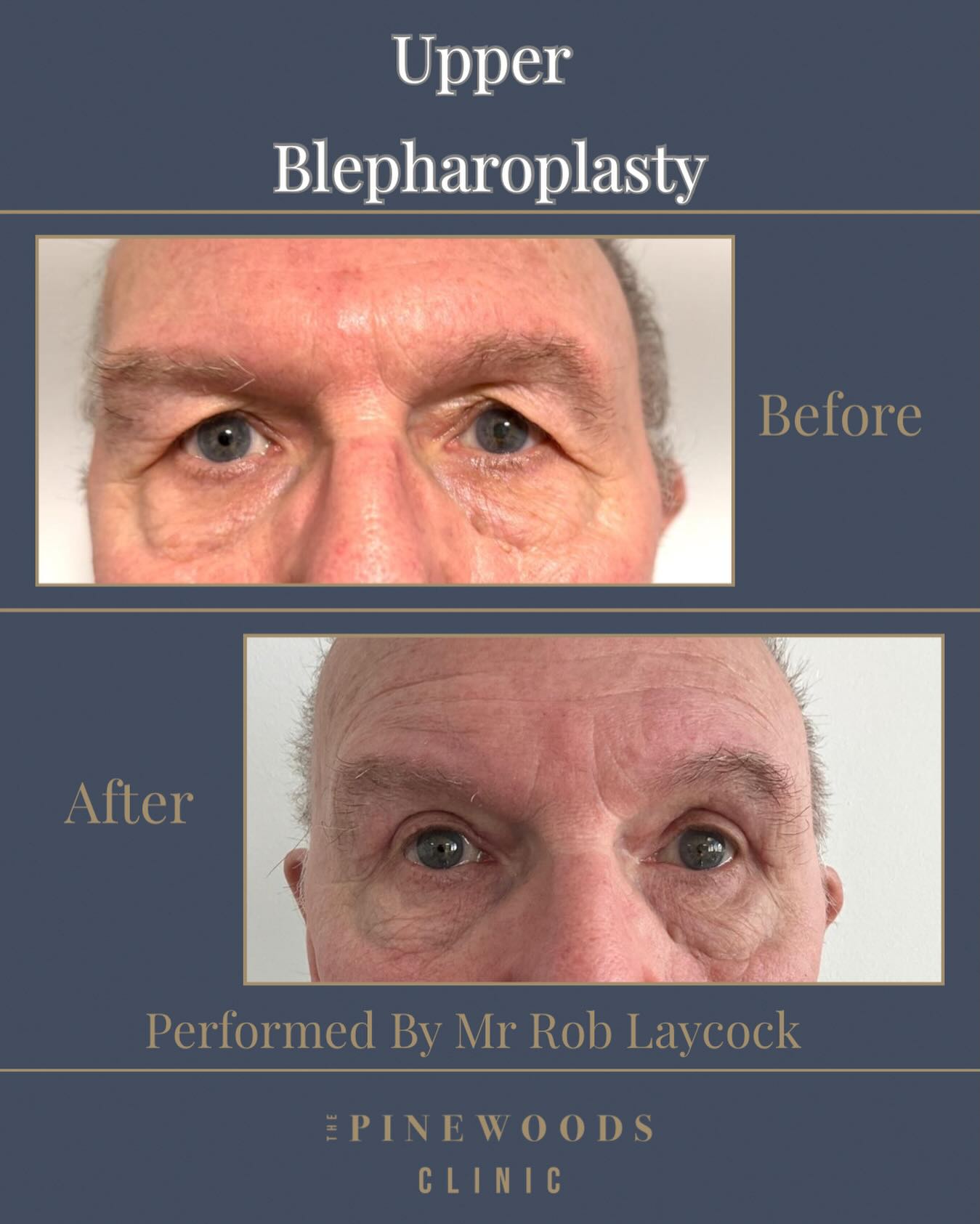
Results vary between patients, and what is achievable in your case is assessed at consultation.
Browpexy lifts and stabilises the outer part of the eyebrow and can be carried out through the same incision as upper eyelid surgery. It suits patients with mild to moderate brow descent, where lifting the brow slightly improves the result and means less eyelid skin needs to be removed.
Canthopexy tightens and supports the outer corner of the eye, where the upper and lower lids meet. At The Pinewoods Clinic it is usually combined with lower blepharoplasty, both to improve the result and to support the lid position afterwards.
Neither adds a separate scar or a separate recovery period when carried out alongside eyelid surgery.
£118 per 3 treatments
£162 per 3 treatments
£162 per 3 treatments
£162 per 3 treatments
£205 per 3 treatments
£259 per 3 treatments
£324 per 3 treatments
£205 per 3 treatments
£259 per 3 treatments
£216 per 3 treatments
£324 per 3 treatments
£378 per 3 treatments
£205 per 3 treatments
£378 per 3 treatments
£432 per 3 treatments
£540 per 3 treatments
£324 per 3 treatments
£378 per 3 treatments
£378 per 3 treatments
£378 per 3 treatments
£540 per 3 treatments
£853 per 3 treatments
£1,080 per 3 treatments
£540 per 3 treatments
£853 per 3 treatments
£378 per 3 treatments
£432 per 3 treatments
£540 per 3 treatments
£324 per 3 treatments
£540 per 3 treatments
£853 per 3 treatments
£1,080 per 3 treatments